
← Back
10th Copernicus Ocean State Report: Understanding a Changing Ocean

The 10th Copernicus Ocean State Report provides a comprehensive assessment of how the ocean is changing and what these changes mean for marine ecosystems and coastal communities worldwide.
Published by Mercator Ocean International as part of the Copernicus Marine Service, the report brings together contributions from 125 scientists from Europe and around the world, including experts from CLS. As a long-standing contributor to the Copernicus Marine Service, CLS supports both the production of essential ocean data and the scientific knowledge that helps us better understand changes taking place across the ocean.
Ten years of continuous monitoring have helped build an increasingly detailed picture of the ocean, making it possible to identify long-term trends, understand extreme events and provide useful information to help societies anticipate and adapt to their impacts.
A major European programme for ocean monitoring
Copernicus Marine is one of the six services of Copernicus, the European Union’s Earth Observation Programme. Funded by the European Union and implemented by Mercator Ocean International, it provides regular information on the state of the ocean at both global and European levels.
CLS is also involved in the operational side of the Copernicus Marine Service, contributing its long-standing expertise in satellite ocean observation and in-situ observations to the production of essential information on sea level, waves, winds and broader ocean conditions.
This information supports a wide range of activities, from climate monitoring and marine protection to maritime safety, sustainable resource management and weather forecasting.
What does the latest report tell us?
The new report highlights the scale and pace of the changes across the ocean. Sea levels continue to rise, the ocean is warming and becoming more acidic, with consequences for marine ecosystems and the communities that depend on them.
Global mean sea level rose at an average rate of 3.8 ± 0.3 mm per year between 1999 and 2025. Over the more recent period from 2012 to 2025, the rate increased to 4.2 ± 0.3 mm per year.. The report also finds that the ocean became approximately 17% more acidic between 1985 and 2025.
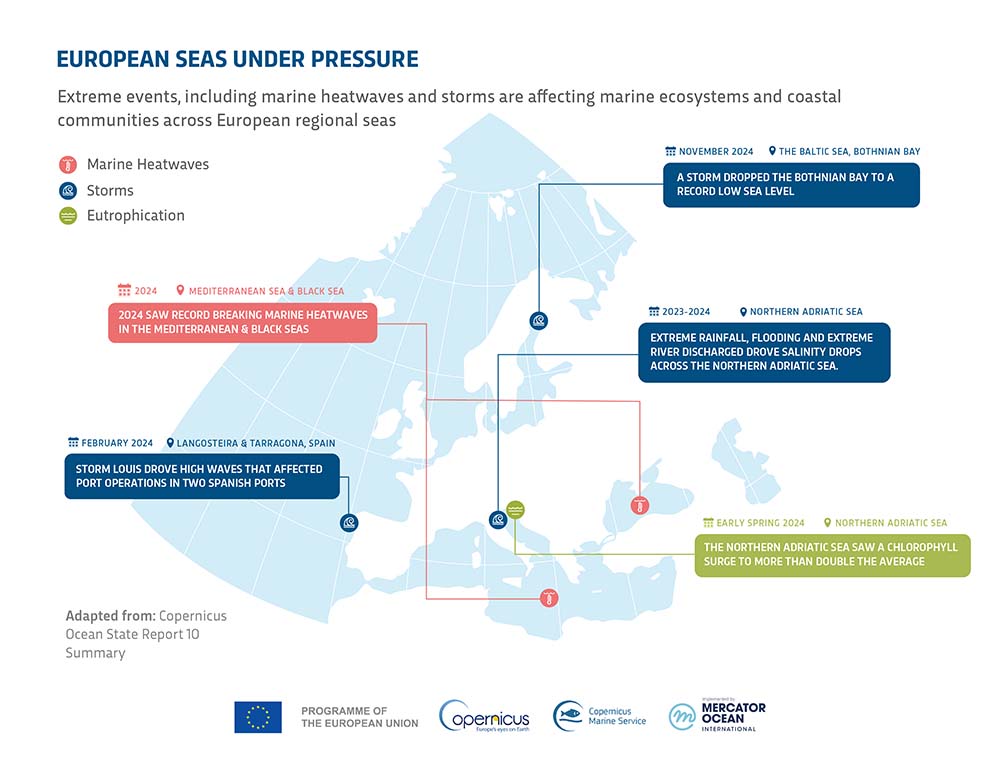
Europe is experiencing these changes first-hand. In 2024, the Mediterranean and Black Seas experienced record-breaking and persistent marine heatwaves. The report also examines extreme sea-level and wave events that disrupted ports, ferry services and coastal infrastructure across European regional seas.
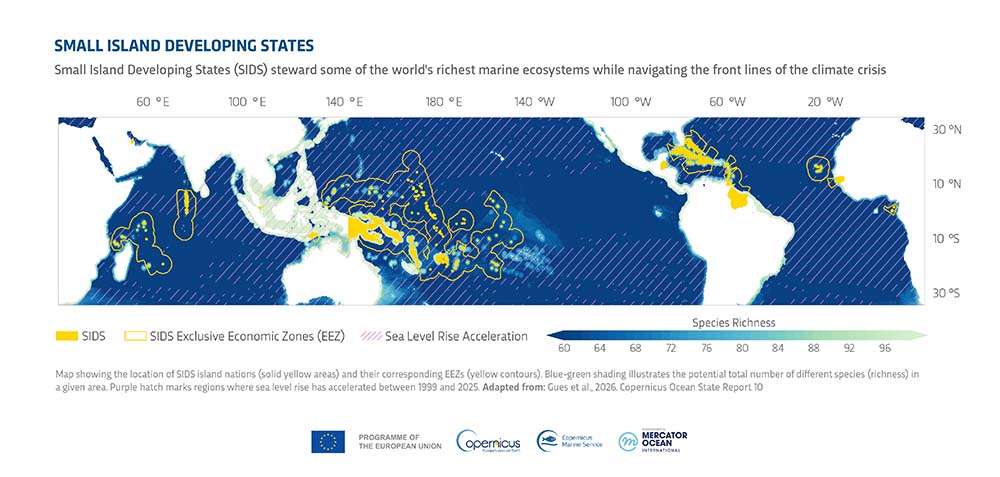
Beyond Europe, it highlights the particular vulnerability of Small Island Developing States, where rising sea levels and warming waters can have major consequences for ecosystems, infrastructure and local economies. Significant changes are also being observed in polar regions, including the continued retreat of Arctic sea ice.
From observation to action
A central message of this anniversary edition is the importance of sustained ocean observation. Long-term monitoring reveals changes year after year, makes it possible to identify trends, better understand emerging risks and provide information that governments and communities can use to prepare.
For CLS, contributing to the Copernicus Marine Service means being part of this wider European effort to turn ocean observations into reliable and useful information. From the production of operational ocean data to scientific contributions such as the analysis of sea-level change in the Mediterranean, this work helps improve our understanding of how the ocean is evolving.
The 10th Copernicus Ocean State Report demonstrates what a decade of continuous observation can achieve: a clearer understanding of the changes already underway and stronger knowledge to help anticipate what comes next.
Discover the Report and read the full press release.
Related Posts:
 Silence is Golden: CLS Acquires Quiet-Oceans for a Quieter Ocean
 Indonesia Selects France and CLS to Boost Marine Weather Capabilities with Landmark $100M Contract
 CLS Acquires Ground Control to Strengthen Global Satellite IoT Offering & Environmental Impact
 Biodiversity Is Changing Too Fast to Measure. France May Have Found a Solution.