
← Back
Supporting Sustainable Agricultural Supply Chains with Geospatial Intelligence
As agriculture faces growing environmental and regulatory pressures, geospatial intelligence for sustainable supply chains is becoming increasingly important.
The European Union Deforestation Regulation (EUDR) compliance deadline for medium to large businesses will come into effect at the end of 2026. The need for organisations to have enterprise traceability and compliance systems in place is critical. Beyond regulatory compliance, this shift reflects a broader expectation from governments, businesses and consumers: understanding where agricultural commodities come from and demonstrating that they have been sourced responsibly.
Drawing on decades of expertise in Earth observation and geospatial intelligence, TraceMark™ helps organisations transform supply chain and location data into actionable insights.
By combining supplier information, satellite imagery and environmental analysis, the platform provides greater visibility into sourcing networks, helping businesses assess environmental risks, strengthen due diligence and support more sustainable sourcing practices. Whether preparing for evolving regulations or advancing broader sustainability commitments, organisations are increasingly recognising that better decisions begin with better data.
The scale of the challenge
Agricultural expansion drives almost 90% of global deforestation.
According to the Food and Agriculture Organization of the United Nations (FAO), more than half of global deforestation is caused by the conversion of forests into cropland, while livestock grazing accounts for almost 40%.
As global demand for agricultural commodities continues to grow, improving the transparency and sustainability of supply chains has become a priority for governments, businesses and consumers alike.

From traceability to transparency
The key challenge for many organisations remains the need for central enterprise management of supplier data and supply chain compliance. Enabling smarter risk prioritisation, smoother audits and ultimately, uninterrupted access to EU markets.
A single product may pass through multiple farms, cooperatives, processors and exporters before reaching its final destination. Verifying where commodities originate and understanding the environmental conditions surrounding production quickly becomes a significant undertaking.
As regulations such as the EUDR introduce new due diligence requirements, businesses must stay ahead of the curve, implementing an enterprise platform and system of record for traceability and compliance, often supported by a GIS capability in-house, but with many organisations lacking this internal resource, a specialist geospatial partner is fast becoming essential, not optional.
Preparing for this level of transparency cannot be achieved overnight. Mapping sourcing regions, collecting accurate geolocation data and verifying historical land use across hundreds or even thousands of suppliers requires time, coordination and the right digital tools.
Why geospatial intelligence matters for sustainable supply chains
Traditional traceability systems tell organisations who supplied a product.
Geospatial intelligence helps answer where it was produced and what is happening on the ground.
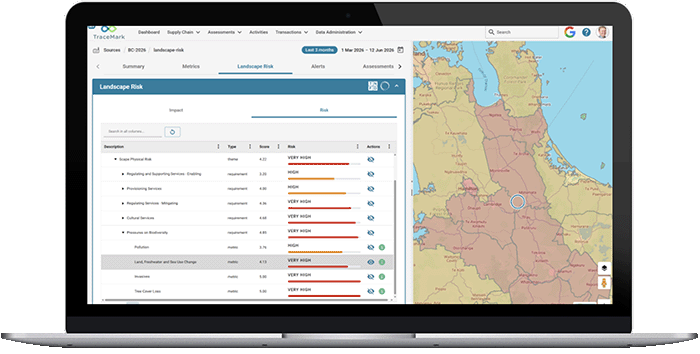
By combining satellite imagery, mapping technologies, geospatial analytics and te use of AI models with supplier information, organisations can better understand their sourcing networks and monitor how landscapes evolve over time.
Unlike traditional traceability systems, geospatial intelligence provides an independent view of the landscape. It allows organisations to move beyond declarations by supporting decisions with objective environmental evidence.
Why use geospatial intelligence?
By integrating satellite-derived information into supply chain management, organisations can:
- Provide a data driven approach for key risk frameworks
- Produce Due Diligence Statements and Compliance Reports
- Verify the location of production areas.
- Map complex sourcing networks.
- Analyse historical land use.
- Monitor land cover change over time.
- Assess environmental risks.
- Support due diligence with objective evidence.
- Strengthen transparency across agricultural supply chains.
By transforming location data into actionable insights, geospatial intelligence enables businesses to make more informed decisions while strengthening confidence in their sustainability commitments.
From insight to action
Understanding supply chains is only the first step. The real value comes from turning that understanding into informed action.
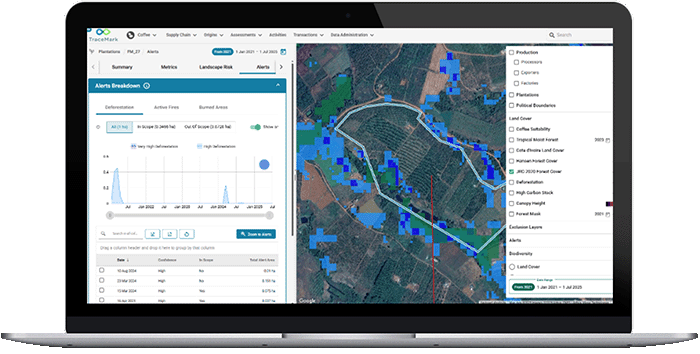
Imagine a coffee importer sourcing beans from hundreds of farms across multiple producing countries. Rather than relying solely on supplier declarations, geospatial intelligence enables each production area to be mapped and assessed using historical satellite imagery and environmental datasets.
This provides an objective view of sourcing locations, helping organisations identify potential risks, prioritise supplier engagement and support due diligence with reliable evidence.
The same approach can be applied across a wide range of commodities, from cocoa and palm oil to soy, cattle, timber and rubber, giving businesses greater confidence in their sourcing decisions.
How TraceMark™ supports sustainable sourcing
TraceMark™ is an end-to-end enterprise traceability platform that combines supply chain management with geospatial intelligence to help organisations build more transparent and resilient sourcing networks.
Designed to support sustainable sourcing and due diligence, the platform brings together supplier information, geospatial data and environmental analysis within a single system, enabling organisations to better understand their supply chains from production to market.
Its capabilities include:
- Supplier onboarding through a dedicated portal.
- End-to-end supply chain mapping.
- Geospatial verification of production areas.
- Satellite-based environmental monitoring.
- Environmental risk assessment.
- Due diligence workflow management.
- Reporting that supports sustainability and regulatory requirements.
- Integration with existing enterprise systems.
By combining enterprise traceability with Earth observation, TraceMark helps organisations strengthen transparency while supporting informed environmental decision-making.

Looking Beyond EUDR
Although the EUDR has accelerated investment in traceability, the benefits extend well beyond a single regulation.
Other EU frameworks are following the same trajectory. The Corporate Sustainability Reporting Directive (CSRD) and Corporate Sustainability Due Diligence (CSDDD) take a broader view, where EUDR is specific to products and deforestation; CSRD and CSDDD extend due diligence and reporting obligations across a whole organisation and the full range of ESG risks.
Organisations who build strong traceability and supplier data foundations now, in response to EUDR, will be better placed to meet broader regulations as they come into full effect.
As expectations around sustainability continue to evolve, transparent supply chains are becoming a strategic advantage rather than simply a compliance requirement.
Building the future of sustainable agriculture
Sustainable agriculture depends on understanding the relationship between production and the environment.
The postponement of the EUDR offers organisations valuable time to prepare, but the broader movement towards transparent and responsible sourcing is already underway.
Businesses that invest today in understanding their supply chains will be better equipped not only to meet future regulatory requirements, but also to strengthen resilience, improve sustainability performance and build long-term trust across their value chains.
By combining enterprise traceability with Earth observation and geospatial intelligence, TraceMark™ helps organisations transform complex supply chains into transparent, verifiable and more sustainable networks.
Because sustainable agriculture begins with knowing where products come from, but its future depends on making informed decisions that protect both production and the landscapes on which it depends.
Related Posts:
 EvoLAND: a New Breakthrough in Water Detection
 Indonesia Selects France and CLS to Boost Marine Weather Capabilities with Landmark $100M Contract
 Partnership for Ecological Transition: CA2BM and CLS Take Action for Net Land Take (ZAN)
 Harnessing AI & Satellites to Map Europe’s Small Landscape Features